

AI Sovereignty Should Be Open Source
Frontier AI models seem to be moving in the direction of an arms race. Every major nation is beginning to ask the same question: what happens if the most powerful AI systems in the world are built, controlled, and hosted by a few companies in a few countries?
This is not a small concern. AI is becoming the interface through which people learn, search, code, create, work, research, trade, and make decisions. In the future, AI will not just answer questions. It will influence how people think.
Ideally, every nation should ensure that it has access to capable models. But I don’t think the answer is for every government to build its own closed frontier model. That would turn AI into a fragmented national arms race where most countries spend massive resources and still remain behind.
The better answer is for governments to support open source AI.
Governments should encourage local startups, researchers, universities, and labs to contribute to open source models. They should provide compute, grants, datasets, incentives, infrastructure, procurement support, and policy clarity.
The goal should not be for every nation to build a closed model for itself. The goal should be for every nation to contribute to the best open source models in the world, and then help its local ecosystem build products using those models.
AI dependence is the new strategic dependence
For decades, countries have worried about dependence on oil, ammunition, semiconductors, telecom equipment, payment networks, energy grids, and food supply chains. AI will soon join that list.
If a nation does not have access to capable AI models, it will be dependent on external nations for intelligence infrastructure. This dependence may be more subtle than previous forms of dependence because AI does not need to stop working in order to become a risk.
If you are dependent on another country for oil, you know when the supply is blocked. If you are dependent on another country for ammunition, you know when shipments stop. But if you are dependent on another country for AI, you may not even know when your intelligence supply is being shaped.
The model may still answer. The product may still work. But the answers may slowly become biased, incomplete, delayed, filtered, restricted, or substandard for users from certain nations.
We have already seen an early version of this risk. When access to Fable 5 and Mythos 5 was restricted for foreign nationals, it showed how quickly a frontier model used globally can become unavailable or limited for users outside the country where it is controlled.
Just today, here’s the below tweet from Sam Altman:
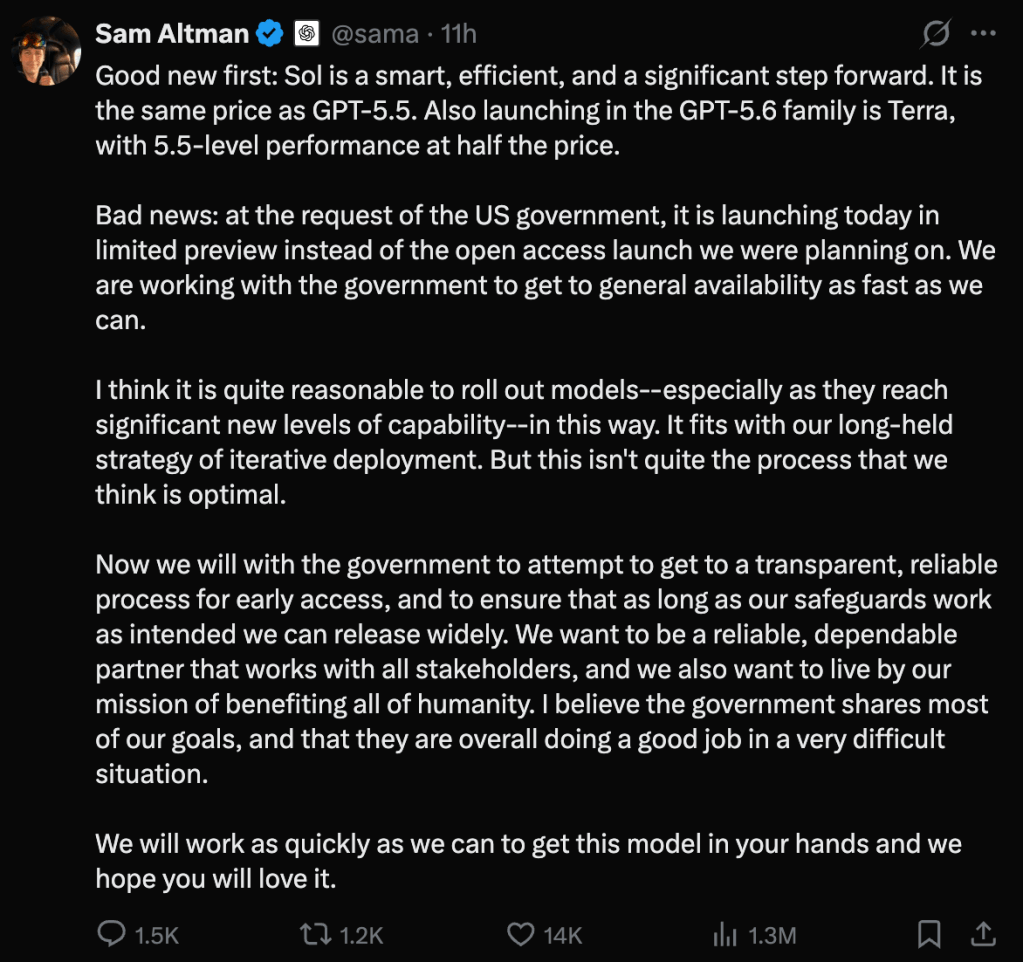
Even if access is later restored or partially restored, the lesson remains the same. If schools, startups, researchers, developers, companies, and public institutions depend entirely on closed models hosted in another country, then access to intelligence infrastructure is not fully in their hands. It can be changed by someone else’s policy decision.
Digital warfare in the AI age may not always look like servers going down or websites being hacked. It may look like students learning less, startups building slower, researchers getting weaker assistance, and citizens being guided toward a narrower understanding of the world, without ever realizing that the system itself is shaping the outcome.
If election interference was a concern with search engines and social media, wait till AI becomes the primary interface to knowledge. AI can single handedly dumb down an entire nation by providing responses in that direction. It may not be the case today, but it can very well happen in the future.
This is why AI sovereignty matters. But sovereignty does not have to mean isolation.
The wrong answer is one closed model per country
A lot of countries may look at the AI race and conclude that they need their own national frontier model. That sounds logical at first because every country wants control over such a critical technology.
But if every country tries to build its own closed model, most will fail.
Frontier models require massive compute, talent, data, research, engineering, infrastructure, product feedback loops, and capital. Only a few countries and companies can keep funding that race at the highest level. Even if a country succeeds once, it has to keep succeeding every few months because AI is moving too fast.
A model that is impressive today can become ordinary in six months. A national closed model strategy can quickly become a trap where countries burn huge resources, create duplication, and still remain behind the global frontier.
Instead of creating hundreds of isolated closed models, nations should work together to strengthen open source AI as a shared global base layer. Every country can contribute what it has, whether that is compute, data, talent, language expertise, research, evaluations, or applications.
The goal should not be separate AI kingdoms. The goal should be the strongest open source AI ecosystem in the world.
Open source is how humanity builds shared infrastructure
History shows us that some of the most important technologies become powerful when they become open, shared, and widely adopted.
The internet did not become powerful because every country built a separate national network. It became powerful because open protocols allowed anyone to connect, build, and innovate.
The web became powerful because it was open enough for universities, companies, developers, and individuals across the world to build on top of it.
Linux became powerful because developers, companies, governments, and universities could all contribute to the same foundation. No single company had to solve every problem alone. The system improved because many people could inspect it, adapt it, deploy it, and contribute back.
The Human Genome Project is another example of what happens when the world treats knowledge as shared infrastructure. Instead of every lab working in isolation, public data helped accelerate research across countries and institutions.
AI should learn from this history. Open systems create compounding progress because many teams can improve the same foundation, and every improvement can help everyone else. Closed systems can also innovate, but their progress is usually controlled by the incentives and priorities of whoever owns them.
The world does not need every country to create its own closed AI kingdom. It needs countries to contribute to shared open source AI infrastructure so that every nation, startup, researcher, and citizen can benefit.
Operating systems and AI models are not the same
Some people may say that countries have always used foreign operating systems and foreign software, so AI should not be treated differently.
But operating systems and AI models are not the same.
Operating systems were mostly on device. You had the software running on your own computer. You could install it, manage it, secure it, and use it locally. Even if the operating system came from another country, the user still had a meaningful degree of control over the device.
AI models are different. The most powerful models today are usually cloud based. The intelligence does not live on your device. It lives on someone else’s servers, under someone else’s policies, in someone else’s jurisdiction.
That means you do not fully control access, quality, continuity, censorship, or the direction in which the model improves. You also do not fully control whether your country, your language, your history, your businesses, your developers, and your citizens are represented well.
This is why open source models matter. And even more importantly, this is why open source models that can run locally or within national infrastructure matter.
Open source models plus intelligence on devices can become the foundation for real digital freedom.
What governments should do
Governments should not try to become AI labs. They should become ecosystem builders.
Their job should be to make it easy for their best startups, researchers, universities, and labs to contribute to open source AI. They should create the conditions where local talent can participate in global AI progress instead of only consuming what foreign companies build.
Every nation can launch an Open Source AI Mission.
Such a mission can include compute grants for startups and researchers contributing to open source models. It can include national AI fellowships for engineers and researchers working on training, inference, evaluations, datasets, local language support, and model optimization.
Governments can create public datasets that are cleaned, documented, and made available for open model training. They can provide incentives for companies that contribute code, data, evaluations, tools, and model improvements to open source AI.
They can give procurement preference to products that use open models and can be deployed locally when needed. This would encourage startups to build practical products on top of open source AI instead of becoming completely dependent on closed foreign APIs.
Local language support should be a major part of this strategy. Every nation has languages, dialects, laws, history, culture, public services, and local context that global AI companies may not prioritize. Governments can help researchers and startups improve open models for these local needs.
Countries can also fund benchmark labs that test models for accuracy, local language performance, coding ability, reasoning, and domain expertise. They can support efficient AI research so that models can run on local servers, edge devices, phones, laptops, and low cost hardware.
The key is that nations should not just consume open source. They should contribute to it.
Every country should ask what it is adding to the global open source AI commons. It could be data, compute, talent, evaluations, local language capabilities, efficient inference, or applications that others can learn from.
That should be the new national AI strategy.
Startups are the bridge between models and citizens
Governments can support the foundation, but startups will bring AI to people.
A model by itself does not change a country. Useful products built on top of that model do.
A farmer needs an assistant that helps with crops, weather, pricing, soil, loans, and government schemes.
A student needs a tutor that understands her language, her curriculum, and her learning level.
A small business owner needs an accountant, marketer, sales assistant, and compliance helper.
A doctor needs tools that help with diagnosis support, patient notes, medical research, and hospital operations.
A developer needs a coding assistant that understands her stack, her codebase, and her deployment environment.
That is where local startups matter.
If countries support open source models, local startups can build products on top of them. They can fine tune for local needs, deploy in local languages, comply with local laws, host locally when needed, and build for local problems that global AI companies may never prioritize.
This is how open source becomes national capability. Not by creating a government chatbot, but by enabling thousands of startups to use open intelligence to solve real problems.
The open source world can win
Many people assume that closed models will always be ahead because they have more money and more compute. Maybe that is true today in some areas, but it does not have to remain true forever.
Open source has one advantage that closed companies cannot easily match: the whole world can contribute.
One company can hire thousands of people, but open source can mobilize millions. One company can collect feedback from its users, but open source can collect improvements from researchers, startups, developers, governments, and communities across the world. One company can optimize for its own business model, but open source can optimize for broader human progress.
If every nation contributes, open source AI can become faster, cheaper, more multilingual, more locally useful, and eventually more intelligent than closed models.
This will require coordination. Countries need to stop thinking only in terms of national closed models. Governments need to see open source AI as strategic infrastructure. Startups need to contribute back instead of only consuming. Universities need to publish useful models, datasets, tools, and evaluations, not just papers. Labs need to work together on shared benchmarks, shared datasets, and shared model improvements.
The open source community also needs to think bigger. The goal should be to build the best open source AI models in the world, make them better than closed models, make them available to every nation, make them usable by every startup, and make them efficient enough to run locally.
That is a future worth building.
The future should not belong to a few closed labs
The future of intelligence is too important to be controlled by a handful of closed labs.
AI will shape education, healthcare, governance, software, science, media, defense, commerce, and culture. No country should be comfortable outsourcing that completely.
But the answer is not AI nationalism. The answer is open collaboration.
The best national AI strategy is not to build a closed model alone. The best national AI strategy is to contribute to open source models with the rest of the world, and then build local products on top.
That is how nations become stronger without fragmenting the world. That is how startups get a fair chance. That is how researchers collaborate across borders. That is how humanity avoids dependence on a few closed systems.
(Open source models) + (on-device Intelligence) = True Freedom for humanity


Leave a comment